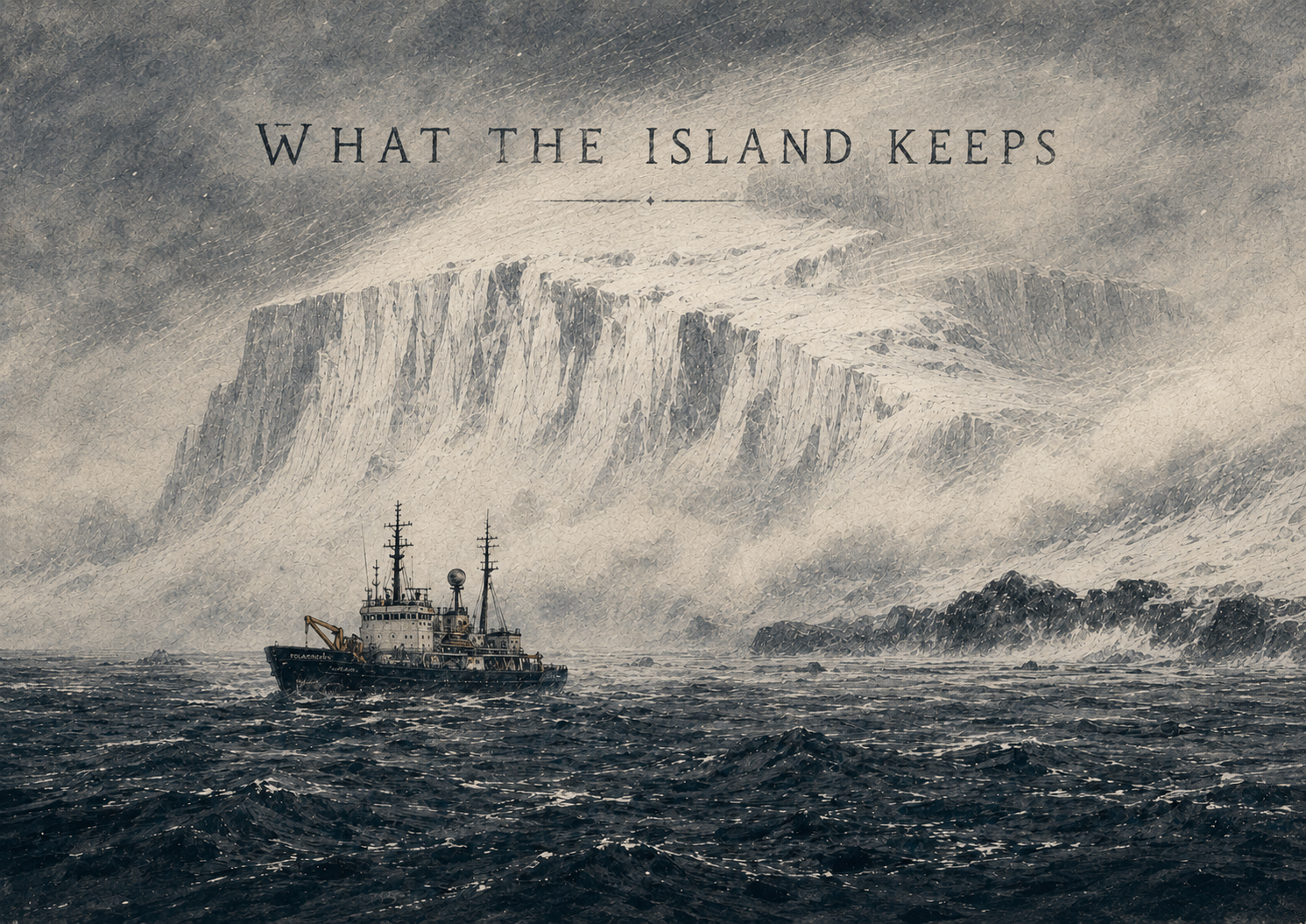
On 26 December 1825, four British sailors watched their small sealing vessel disappear beneath the freezing water off the western edge of the Kerguelen archipelago.
Wrong turn approved.
A Hunting Trip Into the Island of Desolation
John Nunn was twenty-two years old when he sailed from England aboard the Royal Sovereign in 1825.
The ship was heading for Kerguelen, then widely known among sailors as the Island of Desolation. Its crew had not come to explore the landscape or establish a settlement. They had come to hunt seals and elephant seals for skins and oil.
The usual method was risky but efficient. The larger ship anchored in a protected bay while smaller boats carried groups of men to distant beaches. These hunting parties could remain away for days or weeks before returning with their cargo.
Nunn joined one of those expeditions.
It nearly killed him twice.
In November 1825, a small boat called the Francis was destroyed against the rocks of Saddle Island during severe weather. Nunn and three companions survived and were eventually found after fourteen days.
It should have been enough of a warning.
Less than two months later, they returned to the same hostile coast aboard another small vessel: the Favourite.
On 26 December, the sea took that boat too.
The Wreck of the Favourite
The Favourite struck rocks near Saddle Island and began to sink.
The four men had only minutes to act. They built a rough raft, saved what equipment they could and forced their way ashore before the vessel disappeared.
The group was led by second mate James Lawrence. With him were John Nunn, John Manning and James Stilliman, who was only about sixteen years old.
They had survived the wreck.
That was the easy part.
Their mother ship, the Royal Sovereign, searched for them for approximately three weeks. But the coastline was broken by islands, cliffs, bays and violent seas. The searchers found no trace of the men.
The captain concluded that the crew of the Favourite had died.
The Royal Sovereign sailed away.
The four survivors had no way of knowing when the search ended. They could only continue watching the sea, expecting a sail that never appeared.
At some point, hope had to change shape.
Rescue was no longer a plan.
Survival was.
The First Shelter
Saddle Island offered little protection.
The men were stranded on the archipelago's western side, exposed to weather arriving across the open ocean. The wind could turn basic movement into exhausting work. Rain, sleet and snow soaked clothing that could not be replaced. The landscape offered almost no wood.
They recovered a dinghy from the wreckage and found an abandoned boat called the Loon on the shore. It was no longer seaworthy, but its damaged hull could still provide shelter.
They turned it into a home.
It was cramped, wet and temporary, but it kept some of the weather away. Inside, four men tried to sleep while the wind moved around the wreck like another living thing.
Everything had to be saved.
Rope became repair material. Seal skins became clothing and bedding. Animal fat became fuel. Small pieces of metal became tools. Anything washed ashore might mean the difference between discomfort and death.
The island did not give them much.
What it gave them, they learned not to waste.
Eating What the Island Allowed
Fresh water was not the main problem. Kerguelen had streams, pools and constant precipitation.
Food was more complicated.
The survivors depended on whatever was available during each season:
- seals,
- elephant seals,
- fish,
- ducks and other birds,
- eggs collected from nesting areas,
- edible plants including Kerguelen cabbage.
Blubber became one of their most important resources. It could be burned for heat and light and used as cooking fat. Seal skins helped replace clothing that was steadily disintegrating.
But an island full of animals did not mean food was easy to obtain.
The men were cold, under-equipped and increasingly dressed in improvised materials. Hunting required energy. Failed hunting meant less energy for the next attempt. Storms could make beaches inaccessible and prevent them from using the dinghy.
Their survival depended on a cycle that could not be interrupted:
hunt, repair, cook, dry, sleep, repeat.
A serious injury could destroy that cycle.
So could a lost boat.
So could several days of bad weather.
Moving Across Kerguelen
The men eventually understood that Saddle Island could not sustain them indefinitely.
They repaired the abandoned Loon well enough to risk a journey. In the southern summer of 1826, they crossed toward the main island and searched for a less exposed place to live.
They reached a small coastal point on the eastern side of the archipelago, south of Cape Digby.
There, they built something more permanent.
They cut and stacked large blocks of peat to form thick walls. They covered the structure as well as their limited materials allowed and gave it a name that said more about their mental state than its architecture:
Hope Cottage
The hut was crude, dark and smoky.
It was also home.
Compared with the wrecked boat on Saddle Island, Hope Cottage offered real protection. Its peat walls held back part of the wind and helped retain heat. The location gave them access to hunting areas and a base from which they could explore.
Their circumstances remained brutal, but they were no longer merely reacting to disaster.
They had begun to build a life inside it.
The Enemy Was Not Hunger Alone
Stories of castaways often focus on food.
On Kerguelen, the weather was just as dangerous.
The archipelago lies in a belt of powerful westerly winds. Conditions can change quickly, turning a manageable journey into a fight to return alive. Wet clothing offered little insulation. Fire required fuel and constant attention. Salt, smoke and animal fat worked their way into everything.
The men's clothes gradually fell apart.
They repaired garments again and again, combining scraps of cloth with skins and whatever material they could salvage. Their equipment wore down with every expedition. Tools broke. Boats leaked. Shelter required maintenance.
There was no replacement supply.
No one was coming next week.
Every damaged object represented a smaller future.
The psychological pressure must have been equally severe. They did not know whether anyone believed they were alive. They did not know when another vessel might visit the archipelago. A year could pass without a ship appearing near their part of the coast.
The horizon became both promise and punishment.
Leaving Signs for People Who Might Never Come
The castaways knew that simply surviving was not enough.
A ship could visit Kerguelen and leave without ever seeing them. The archipelago is large, deeply indented and surrounded by hundreds of smaller islands. Four men and one peat hut could disappear inside it completely.
So they created signs.
They placed messages and markers at prominent locations, hoping that a visiting crew might discover one and begin searching.
It was an act of faith stretched across geography.
Each sign had to survive wind, rain and time.
Each one carried the same essential message:
We are alive.
We are somewhere on these islands.
Find us.
For years, no answer came.
The Sail on the Horizon
In March 1828, more than two years after the wreck of the Favourite, sailors from the cutter Lively found one of the castaways' signs near Shallop Bay.
This time, the message worked.
The crew began to search.
When they finally found Nunn and his companions, the four men had been living as castaways since December 1825. Their survival depended on shelters built from wreckage and peat, clothing repaired with animal skins, improvised tools and an intimate knowledge of the seasons.
The rescuers took them aboard.
But their story on Kerguelen was not yet over.
The Lively was operating with the schooner Sprightly, commanded by Captain Alexander Distant. The ships had come to Kerguelen for a planned hunting campaign and did not immediately return to England.
The former castaways remained with them for another year.
Only at the end of March 1829 did the ships finally leave the archipelago.
John Nunn had arrived at Kerguelen in August 1825.
He departed approximately three years and seven months later.
The Man Who Returned From Desolation
Nunn reached England in the summer of 1829.
His later life was not easy. After returning to maritime work, an accident cost him two fingers and damaged his right hand, limiting his ability to work as a full sailor.
Years later, physician and naturalist William Barnard Clarke heard Nunn's account and helped transform it into a book.
In 1850, it appeared under the title:
The Narrative of the Wreck of the "Favourite" on the Island of Desolation: Detailing the Adventures, Sufferings, and Privations of John Nunn.
The book was more than an adventure story. It recorded observations of Kerguelen's geography, wildlife, weather and sealing industry at a time when the archipelago remained poorly understood in Europe.
It also preserved the names of four men who might otherwise have vanished into the same silence that nearly killed them.
- James Lawrence
- John Nunn
- John Manning
- James Stilliman
All four survived.
How Did They Survive?
Their survival was not the result of one miraculous discovery.
It was a chain of practical decisions repeated for years.
They stayed together
Lawrence, Nunn, Manning and Stilliman worked as a group. Tasks could be divided, injuries managed and knowledge shared.
They recovered everything possible
The wreck was not only a disaster. It was also their only storehouse. Boats, rope, fabric, metal and tools were reused until they could no longer function.
They adapted their diet
They ate according to the seasons and used more than just the meat of the animals they hunted. Blubber provided heat, light and cooking fuel. Skins became clothing and shelter material.
They moved to a better location
Instead of remaining permanently on Saddle Island, they repaired a boat and searched for a place where long-term survival was more realistic.
They built Hope Cottage
The peat hut gave them a more stable base and improved their chances of surviving additional winters.
They made themselves discoverable
Their signs eventually brought the crew of the Lively to them. Without those markers, a ship could have passed through Kerguelen without ever knowing they were there.
Reel vs Reality
The cinematic version
Four sailors are wrecked on an empty island, build a hut and wait three and a half years for a ship to rescue them.
The documented story
The reality was more complex:
- Nunn reached Kerguelen with the Royal Sovereign in August 1825.
- The Favourite sank on 26 December 1825.
- The four men survived independently until they were found in March 1828.
- They then remained aboard visiting hunting vessels while those ships continued operating around Kerguelen.
- They finally left the archipelago in March 1829.
They were true castaways for more than two years and remained on Kerguelen for approximately three and a half years in total.
That distinction does not make the story less extraordinary.
It makes it more human.
Their rescue did not arrive as a clean ending. Even after being found, home was still another year away.
What Remains
Kerguelen is no longer completely without human presence. France now maintains scientific and technical operations on the archipelago.
But much of the landscape Nunn described remains recognisable:
- treeless valleys,
- black volcanic rock,
- vast colonies of seabirds and marine mammals,
- cold rain,
- low cloud,
- wind moving uninterrupted across the ocean.
The modern world has reached Kerguelen.
It has not made the islands ordinary.
Nearly two centuries after the wreck of the Favourite, John Nunn's story still captures what makes the archipelago unsettling: not that survival there is impossible, but that the islands can reduce life to its most basic systems.
Shelter.
Food.
Fire.
Companionship.
And the hope that somewhere beyond the weather, another human being might find the message you left behind.